
Short answer: apply Formic Pro in the cool of the morning, once the temperature has reached at least 10°C and the bees are active. More important than the exact hour is the forecast: the daytime temperature should remain between 10°C and 29.5°C for the first three days of treatment, and rain should be avoided on the first day.
Do not wait until evening to apply Formic Pro as a way of working around a hot forecast. Most of the formic acid vapour is released during the first three days, so the conditions over that whole period—not just the temperature when you open the packet—are what matter.
Why a cool morning is usually best
Formic Pro works by releasing formic acid vapour through the hive. The colony helps circulate that vapour by fanning, so the bees need to be active rather than tightly clustered.
A cool, dry morning is usually the easiest window because:
- the day is less likely to begin near the upper temperature limit;
- bees are becoming active and can ventilate the colony;
- you have daylight to observe the entrance after the hive is closed; and
- you are not relying on a cool evening to compensate for an unsuitable hot day.
If the morning is below 10°C, wait until it warms above 10°C and the colony is active. The manufacturer’s Australia/New Zealand guide says that overnight lows are not the deciding factor; the daytime temperature range during the first three days is what matters.
Check the three-day forecast before opening the packet
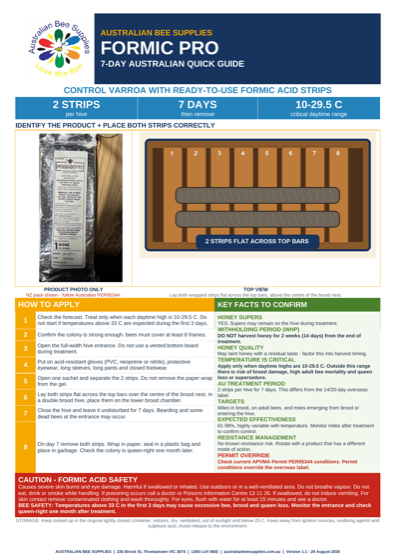
Before treating, check that the forecast daytime temperatures will stay within 10°C to 29.5°C for the first three days. The Australian permit also warns that temperatures above 33°C during those first three days may cause excessive bee, brood or queen loss.
Choose a dry first day. If the forecast is marginal or likely to change, postpone treatment until there is a suitable window.
Prepare the hive for safe ventilation
Correct ventilation is essential during treatment. Follow the Australian permit and the instructions supplied with the product. In particular:
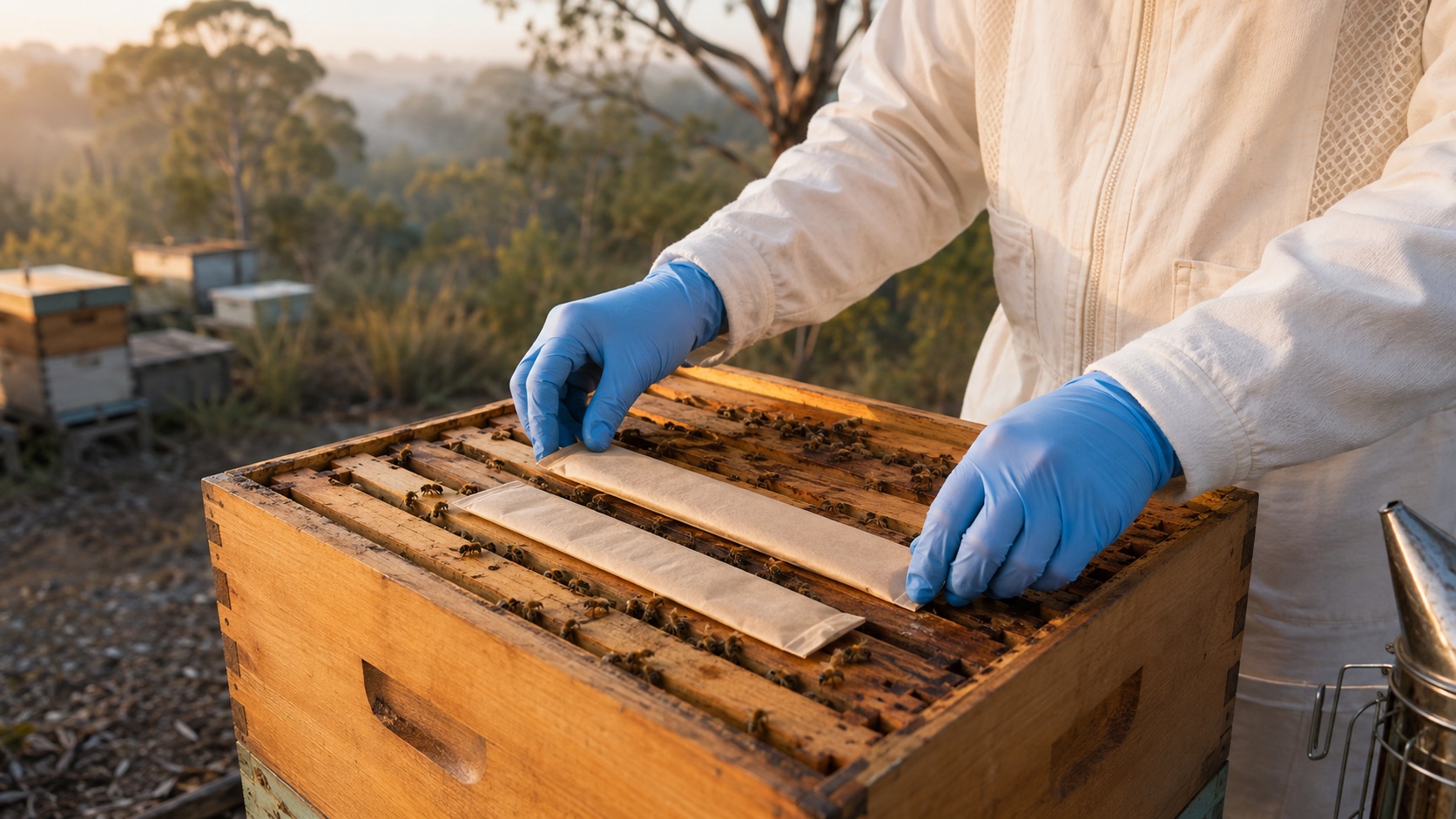
- use two strips per hive and leave them in place for seven days;
- keep the eco-paper wrap on the strips;
- ensure the bottom entrance is fully open across the width of the hive for the whole treatment;
- remove entrance reducers or other restrictions;
- close screened bottom boards, as they do not replace a fully open entrance;
- treat only a sufficiently strong colony—about 10,000 bees or bees covering six 23 cm deep frames; and
- do not disturb the brood nest during the seven-day treatment.
Formic acid can cause serious skin and eye injury and its vapour is harmful. Wear the personal protective equipment specified by the permit, including acid-resistant gloves and protective eyewear, work outdoors, stand upwind and keep the product away from the smoker and other ignition sources.
Remember the Australian directions are different
Formic Pro directions published for other countries can differ from the Australian requirements. In Australia, use must follow APVMA emergency permit PER95344, which overrides conflicting overseas label directions. At the time of writing, the permit applies in NSW, ACT, Victoria and Queensland. Check that the permit is current and applies in your location before use.
The Australian directions require two strips per hive for seven days. Honey must not be harvested until two weeks after the end of treatment, and treatment records must be kept as required by the permit.
Frequently asked questions
Can I apply Formic Pro in the evening?
The exact hour is less important than the three-day weather window. An evening application does not make a forecast above the permitted temperature range safe. A cool morning after the air has reached 10°C is generally the clearer practical choice because the bees are active and you can observe the entrance afterwards.
What if it is colder than 10°C overnight?
The Australia/New Zealand manufacturer guide says overnight lows are not the deciding factor. Check that the daytime temperature is within 10°C to 29.5°C during the first three days, and apply when the bees are active rather than clustered.
Should I use one strip in warm weather?
No. The current Australian directions specify two strips per hive. Do not substitute overseas one-strip schedules. If the weather is unsuitable, wait for an appropriate treatment window rather than changing the dose.
Need help planning your treatment?
View Formic Pro at Australian Bee Supplies or contact the ABS team before opening the packet if you are unsure about your hive configuration, colony strength or the forecast. Always read and follow the current Australian permit and the product instructions supplied with your pack.