
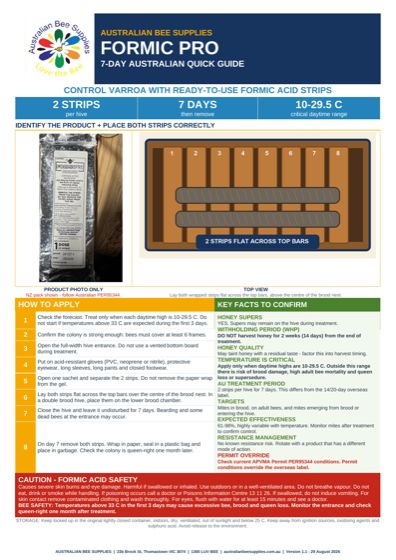
Short answer: apply Formic Pro in the cool of the morning, once the temperature has reached at least 10°C and the bees are active. More important than the exact hour is the forecast: the daytime temperature should remain between 10°C and 29.5°C for the first three days of treatment, and rain should be avoided on the first day.
Do not wait until evening to apply Formic Pro as a way of working around a hot forecast. Most of the formic acid vapour is released during the first three days, so the conditions over that whole period—not just the temperature when you open the packet—are what matter.
Why a cool morning is usually best
Formic Pro works by releasing formic acid vapour through the hive. The colony helps circulate that vapour by fanning, so the bees need to be active rather than tightly clustered.
A cool, dry morning is usually the easiest window because:
- the day is less likely to begin near the upper temperature limit;
- bees are becoming active and can ventilate the colony;
- you have daylight to observe the entrance after the hive is closed; and
- you are not relying on a cool evening to compensate for an unsuitable hot day.
If the morning is below 10°C, wait until it warms above 10°C and the colony is active. The manufacturer’s Australia/New Zealand guide says that overnight lows are not the deciding factor; the daytime temperature range during the first three days is what matters.
Check the three-day forecast before opening the packet
Before treating, check that the forecast daytime temperatures will stay within 10°C to 29.5°C for the first three days. The Australian permit also warns that temperatures above 33°C during those first three days may cause excessive bee, brood or queen loss.
Choose a dry first day. If the forecast is marginal or likely to change, postpone treatment until there is a suitable window.
Prepare the hive for safe ventilation
Correct ventilation is essential during treatment. Follow the Australian permit and the instructions supplied with the product. In particular:
- use two strips per hive and leave them in place for seven days;
- keep the eco-paper wrap on the strips;
- ensure the bottom entrance is fully open across the width of the hive for the whole treatment;
- remove entrance reducers or other restrictions;
- close screened bottom boards, as they do not replace a fully open entrance;
- treat only a sufficiently strong colony—about 10,000 bees or bees covering six 23 cm deep frames; and
- do not disturb the brood nest during the seven-day treatment.
Formic acid can cause serious skin and eye injury and its vapour is harmful. Wear the personal protective equipment specified by the permit, including acid-resistant gloves and protective eyewear, work outdoors, stand upwind and keep the product away from the smoker and other ignition sources.
Remember the Australian directions are different
Formic Pro directions published for other countries can differ from the Australian requirements. In Australia, use must follow APVMA emergency permit PER95344, which overrides conflicting overseas label directions. At the time of writing, the permit applies in NSW, ACT, Victoria and Queensland. Check that the permit is current and applies in your location before use.
The Australian directions require two strips per hive for seven days. Honey must not be harvested until two weeks after the end of treatment, and treatment records must be kept as required by the permit.
Frequently asked questions
Can I apply Formic Pro in the evening?
The exact hour is less important than the three-day weather window. An evening application does not make a forecast above the permitted temperature range safe. A cool morning after the air has reached 10°C is generally the clearer practical choice because the bees are active and you can observe the entrance afterwards.
What if it is colder than 10°C overnight?
The Australia/New Zealand manufacturer guide says overnight lows are not the deciding factor. Check that the daytime temperature is within 10°C to 29.5°C during the first three days, and apply when the bees are active rather than clustered.
Should I use one strip in warm weather?
No. The current Australian directions specify two strips per hive. Do not substitute overseas one-strip schedules. If the weather is unsuitable, wait for an appropriate treatment window rather than changing the dose.
Need help planning your treatment?
View Formic Pro at Australian Bee Supplies or contact the ABS team before opening the packet if you are unsure about your hive configuration, colony strength or the forecast. Always read and follow the current Australian permit and the product instructions supplied with your pack.
Authoritative references
- APVMA emergency permit PER95344
- National Varroa Mite Management Program: Formic Pro
- NOD Apiary Products: Australia/New Zealand Formic Pro guide
Varroa destructor is now established in Australia, and slow-release oxalic acid strips have become one of the most convenient treatment options for beekeepers. This guide covers Aluen CAP, a 42-day slow-release oxalic acid strip treatment, including how it works, how to apply it correctly, and where to buy it.
Haven’t checked your mite levels yet? Read our guide to Varroa mite testing in Australia first, then come back here once you know treatment is needed.
What Is Aluen CAP?
Aluen CAP strips are a slow-release oxalic acid dihydrate treatment for Varroa mites in honey bee colonies. Each strip releases its active ingredient continuously over approximately 42 days as bees walk across it, spreading the treatment through contact throughout the hive. Strips are single-use and registered for use once per year, and not over two consecutive treatment periods.
Key Facts at a Glance
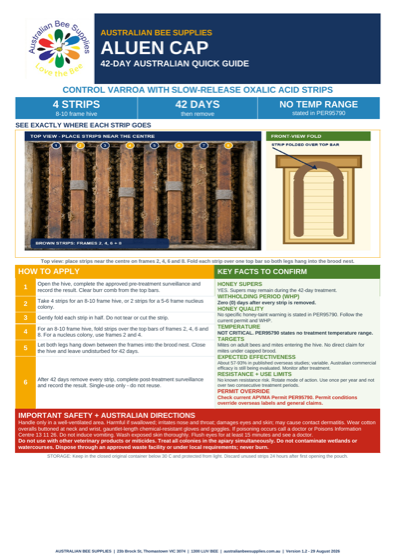
- Pack sizes: 4 strips treat an 8–10 frame hive; 2 strips treat a 5–6 frame nucleus colony.
- Duration: 42 days, then remove every strip.
- Honey supers: may remain on the hive during the 42-day treatment.
- Withholding period: zero (0) days after every strip is removed.
- Temperature range: not stated in the current permit (PER95790) — not a critical factor for this product.
- Targets: mites on adult bees and mites entering the hive. There is no direct claim of effectiveness against mites under capped brood.
- Expected effectiveness: roughly 57–93% based on published overseas studies; performance under Australian commercial conditions is still being evaluated, so monitor mite levels after treatment.
- Resistance risk: none currently known. Rotate mode of action between treatments as good practice.
Always check the current APVMA permit (PER95790) before treating — permit conditions override any overseas label claims or general advice, including this guide.
How to Apply Aluen CAP
- Open the hive, complete your pre-treatment mite surveillance, and record the result. Clear any burr comb from the top bars.
- Take 4 strips for an 8–10 frame hive, or 2 strips for a 5–6 frame nucleus colony.
- Gently fold each strip in half. Do not tear or cut the strip.
- For an 8–10 frame hive, fold strips over the top bars of frames 2, 4, 6 and 8. For a nucleus colony, use frames 2 and 4.
- Let both legs of each strip hang down between the frames into the brood nest. Close the hive and leave undisturbed for 42 days.
- After 42 days, remove every strip and complete your post-treatment mite surveillance. Strips are single-use — do not reuse.
Safety and Handling
Handle Aluen CAP only in a well-ventilated area. It is harmful if swallowed and irritates the nose, throat, eyes and skin, and may cause contact dermatitis. Wear cotton overalls buttoned at the neck and wrist, gauntlet-length chemical-resistant gloves, and goggles. If poisoning occurs, call the Poisons Information Centre on 13 11 26 or a doctor. Do not induce vomiting. If eyes are exposed, flush with water for at least 15 minutes and see a doctor.
- Do not use alongside other veterinary medicines in the apiary, and treat all colonies in the apiary at the same time.
- Do not contaminate wetlands or waterways. Dispose of used strips through an approved waste facility, or as required by your local council. Never burn.
- Storage: keep strips in the closed original container, below 30°C and protected from light. Discard any unused strips within 24 hours of opening the pouch.
Want the full instructions on hand at the hive? Download our printable Aluen CAP quick guide below.
Shop Aluen CAP
Aluen CAP is available from our shop in a 1 Pack (60 strips) or 1 Box (360 strips): Varroa Treatment | Aluen CAP | Slow Release Oxalic Acid Strips. Prefer to shop on eBay? You’ll also find it on our eBay listing.
Not sure Aluen CAP is the right fit for your hives? Have a look at our full range of Varroa testing and treatment products.
Introduction:
Australia’s unique biodiversity is home to an array of flora and fauna, including the precious honeybee. However, the threat of varroa mites looms large over our buzzing friends. These parasitic mites pose a significant risk to bee populations worldwide, causing devastation to colonies if left unchecked. In Australia, vigilant monitoring and testing are essential to safeguarding our bees against this formidable foe.
Understanding Varroa Mites:
Varroa mites (Varroa destructor) are tiny external parasites that feed on the bodily fluids of honeybees. They reproduce within bee colonies, weakening adult bees and causing deformities in developing larvae. If left untreated, varroa mites can decimate entire bee populations, leading to devastating consequences for both beekeepers and agricultural ecosystems.
Varroa Mite Testing Methods:
- Sugar Shaker Test: The sugar shaker test is a simple yet effective method used by beekeepers to detect the presence of varroa mites in their hives. Here’s how it works:
- Collect approximately 300 bees from various frames within the hive.
- Place the bees in a jar or container with a fine mesh lid.
- Add powdered icing sugar to the container and shake vigorously for several minutes.
- The sugar dislodges the mites from the bees’ bodies, causing them to fall through the mesh.
- Count the number of mites that have been dislodged and calculate the infestation rate.
- Alcohol Wash Test: The alcohol wash test is another commonly used method for detecting varroa mites in bee colonies. Here’s how it’s done:
- Collect a sample of approximately 300 bees from the hive.
- Place the bees in a container filled with a solution of water and rubbing alcohol.
- Shake the container vigorously to dislodge the mites from the bees’ bodies.
- Strain the solution through a fine mesh to separate the mites from the bees.
- Count the number of mites in the solution to determine the infestation rate.
Varroa Mite Testing in Australia:
In Australia, beekeepers and authorities are actively engaged in varroa mite monitoring and testing efforts to prevent the establishment of these destructive pests. Regular testing using methods such as the sugar shaker test and alcohol wash test helps beekeepers identify and manage varroa mite infestations before they can spread and cause widespread damage.
Conclusion:
As guardians of our precious honeybee populations, it is imperative that we remain vigilant in our efforts to combat the threat of varroa mites. Through proactive monitoring and testing, beekeepers in Australia can play a crucial role in protecting our bees and preserving the delicate balance of our ecosystems. By staying informed and taking action, we can ensure a bright future for our buzzing friends and the vital pollination services they provide.
Together, let’s continue to work towards a world where our bees can thrive free from the menace of varroa mites.
Shop Varroa Testing Supplies
Ready to test your own hives? Grab a Varroa Check Kit or Isopropyl Alcohol for the alcohol wash method from our shop.
If your count comes back above threshold, read our guide on treating Varroa with Aluen CAP slow-release oxalic acid strips for the next step.
Connect with Us:
- Stay updated on beekeeping news and tips by following us on on Instagram.
- Join our community of bee enthusiasts and share your experiences with varroa mite testing.
- Subscribe to our newsletter for the latest updates on bee health and conservation efforts.